
Impact of Stock Dividends and Stock Splits on Earnings Per Share (EPS)
Stock dividends are payment of additional shares of stock to common shareholders. For example, assume a company announces a 5% stock dividend to all shareholders of record. For each 100 shares held, shareholders receive another 5 shares.
In case of stock splits, the firm increases the number of shares outstanding and reduces the price of each share. For example, assume that a company announces a 3-for-2 stock split. For each 100 shares held, shareholders receive another 50 shares.
Stock splits and stock dividends are economically the same. The number of shares outstanding increases and the price of each share drops. The value of the firm does not change. A 3-for-2 stock split is the same as a 50% stock dividend. For each 100 shares held, shareholders receive another 50 shares.
In the calculation of EPS, the Total Weighted Average Common Shares will be affected by stock dividends and stock splits. Let’s take an example to understand this.
Example
A company has net income of $1 million. It paid dividends of $100,000 to its preferred shareholders and also paid dividends of $200,000 to its common shareholders.
The company had 12,000 shares of common stock outstanding on January 1. On March 1, it issued 2700 shares; on July 1, it declared a 20% stock dividend; and on December 1, it acquired 480 shares as treasury stock. The weighted average number of common shares is calculated below:
Step 1: Adjust the pre-dividend number of shares to post-dividend number of shares.
This will be done by multiplying the number of shares prior to declaring dividends by 1.2 (20% dividend).
January 1 12,000*1.2 = 14,400
July 1 2700*1.2 = 3,240
December 1 -480 (No adjustment)
Step 2: Calculate the Total Weighted Average Common Shares
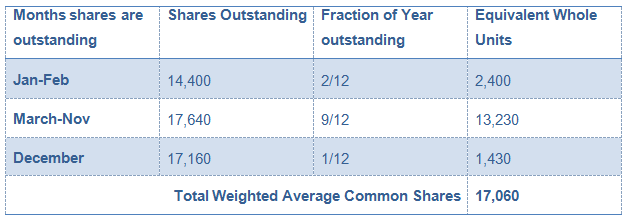
Step 3: Calculate Basic EPS
The Basic EPS of the company will be:
