Demand Function and Demand Curve
The two fundamental principles in microeconomics are the principles of demand and supply of goods and services. At any point of time, the various goods and services will have a certain demand and supply that will depend on a variety of factors.
Demand
Demand refers to the ability and the willingness of consumers to buy certain quantities of goods and services at a given price during a given time period. Demand of a product is affected by many factors such as the cost of production, its price compared to other alternative products, or the income levels of consumers. All these are called the determinants of demands.
For any product, we can calculate the quantity demanded as a function of various factors influencing the demand. The quantity demanded (Qd) is the amount of a good or service consumers are willing & able to purchase during a given period of time.
Factors Affecting Quantity Demanded
The common factors affecting the quantity demanded are:
- Price of good or service (P)
- Incomes of consumers (M)
- Prices of related goods & services (PR)
- Expected future price of product (Pe)
- Number of consumers in market (N)
- Taste patterns of consumers (Á)
General Demand Equation
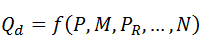
The general demand function with the above determinants will be as follows:
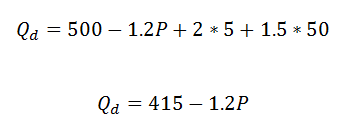
A simple demand function for product X is presented below:

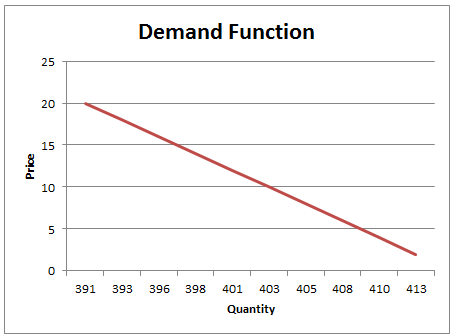
Here 500 is a cumulative of all the factors that are not specified above. The quantity demanded is inversely related to price of the products, i.e., if prices fall, the demand will increase. The quantity demanded is positively related to the price of related goods, i.e., if the price of related goods increases, the quantity demanded for product X will increase. The quantity demanded is also positively related to the income of consumers, i.e., if the income is more, the quantity demanded will be more.
Test Your Knowledge
Check your understanding of this lesson with a short quiz.