Let us consider two assets A and B with the following details:
| Mean | Standard Deviation | Correlation | |
| A | |||
| B |
We have a total of $10 million to invest. Our objective is to reach a target return of $5 million. Let us look at the following three options and find out the probability of reaching our target in each case:
Assuming r as the return from each portfolio, our objective can be expressed as follows:
P (10million*r > 5million)
Or
P (r > 0.5)
We know that if the returns of an asset are normally distributed, it can be expressed as a function of standard normal distribution. We can associate the return distribution to a standard normal distribution, which has a zero mean and a standard deviation of one.
Therefore, our returns can be expressed as follows:
or
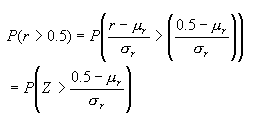
Our probability can be expressed as follows:

Let us now evaluate each of the three portfolios.
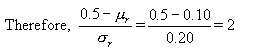
1. Entire $10 million in Asset A

That is, P(Z > 2) = 2.28%
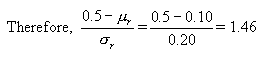
2. Entire $10 million in Asset B

That is, P(Z > 1.46) = 7.19%
3. $5 million in A and $5 million in B
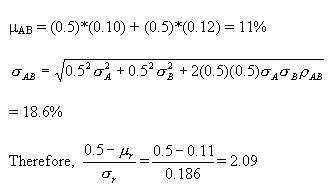
First we need to calculate the expected return and standard deviation of the portfolio.

That is, P(Z > 2.09) = 1.8%
You can observe that the portfolio with the highest risk has the greatest chance of reaching the target, while the diversified portfolio has the least chance of reaching the target.