
Investment Risk and Returns
This is a sample chapter from the ebook Investment Risk and Return Analysis In Python.
Sign in to watch this video
Create a free account or sign in to access this content
Investing in financial markets always involves some level of risk, and understanding the relationship between risk and return is crucial for investors. Risk refers to the uncertainty of the outcome of an investment, while return refers to the profit or loss generated by an investment over time. Investors expect to be compensated for taking on additional risk. Let’s understand the concepts of investment risk and return in more detail.
Understanding Risk
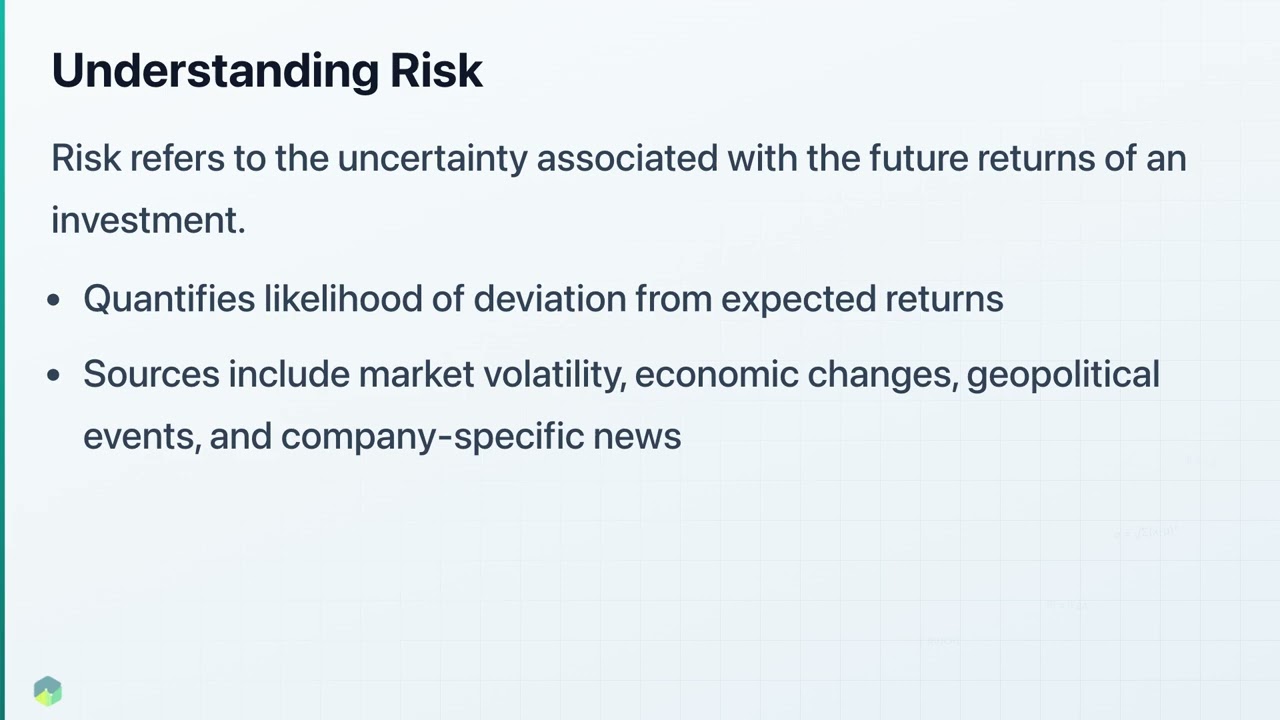
Risk refers to the uncertainty associated with the future returns of an investment. It quantifies the likelihood that the actual returns will deviate from the expected returns. This deviation can stem from a wide array of sources, including market volatility, economic changes, geopolitical events, and company-specific news.
The concept of risk is fundamental to investment decision-making. Investors aim to balance the trade-off between risk and return, seeking to optimize their portfolios according to their risk tolerance, investment horizon, and financial objectives. Understanding risk is crucial not for the purpose of avoiding it, but for making informed decisions that are in alignment with one's investment strategy.
Understanding Financial Returns
Financial returns are the gains or losses generated by an investment over a specific period. They can be expressed in absolute terms or as a percentage of the initial investment. There are two main types of returns:
- Simple Returns: These are calculated by taking the difference between the final value and the initial value of the investment, divided by the initial value. It's a straightforward calculation used for single-period investments. Simple returns are also know as discrete returns.
- Logarithmic Returns (Log Returns): These returns are used for measuring the performance over multiple periods. They are calculated using the natural logarithm of the ratio of the final value to the initial value. Log returns are beneficial for their additive property over time, making them ideal for analyzing the returns of an investment over several periods.
Ebook Sample
You're reading a sample chapter from Investment Risk and Return Analysis In Python
Get the ebook to continue with the full material and included resources.