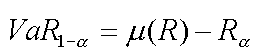
Calculating VaR Using Historical Simulation
The fundamental assumption of the Historical Simulations methodology is that you base your results on the past performance of your portfolio and make the assumption that the past is a good indicator of the near-future.
The below algorithm illustrates the straightforwardness of this methodology. It is called Full Valuation because we will re-price the asset or the portfolio after every run. This differs from a Local Valuation method in which we only use the information about the initial price and the exposure at the origin to deduce VaR.
Step 1 – Calculate the returns (or price changes) of all the assets in the portfolio between each time interval.
The first step lies in setting the time interval and then calculating the returns of each asset between two successive periods of time.
Generally, we use a daily horizon to calculate the returns, but we could use monthly returns if we were to compute the VaR of a portfolio invested in alternative investments (Hedge Funds, Private Equity, Venture Capital and Real Estate) where the reporting period is either monthly or quarterly. Historical Simulations VaR requires a long history of returns in order to get a meaningful VaR. Indeed, computing a VaR on a portfolio of Hedge Funds with only a year of return history will not provide a good VaR estimate.
Step 2 – Apply the price changes calculated to the current mark-to-market value of the assets and re-value your portfolio.
Once we have calculated the returns of all the assets from today back to the first day of the period of time that is being considered – let us assume one year comprised of 265 days – we now consider that these returns may occur tomorrow with the same likelihood. For instance, we start by looking at the returns of every asset yesterday and apply these returns to the value of these assets today. That gives us new values for all these assets and consequently a new value of the portfolio. Then, we go back in time by one more time interval to two days ago. We take the returns that have been calculated for every asset on that day and assume that those returns may occur tomorrow with the same likelihood as the returns that occurred yesterday. We re-value every asset with these new price changes and then the portfolio itself. And we continue until we have reached the beginning of the period. In this example, we will have had 264 simulations.
Step 3 – Sort the series of the portfolio-simulated P&L from the lowest to the highest value.
After applying these price changes to the assets 264 times, we end up with 264 simulated values for the portfolio and thus P&Ls. Since VaR calculates the worst expected loss over a given horizon at a given confidence level under normal market conditions, we need to sort these 264 values from the lowest to the highest as VaR focuses on the tail of the distribution.
Test Your Knowledge
Check your understanding of this lesson with a short quiz.